Held
AI-Native Pregnancy & Postpartum Companion App
- Product Design
- AI-Native Mobile
- Built with Claude Code
It started at 3am. Not with a design brief. Not with a Figma file.
It started years ago, with a phone call from a new parent who was scared, exhausted, and didn't know if what they were feeling was normal. I was their doula. I picked up the phone.
I spent 9 years as a full-spectrum doula supporting people through fertility, pregnancy, birth, and the weeks after. And one thing became clear to me over and over again: the support doesn't stop at birth. But most products do.
That's the gap Held was built to fill.
The Problem
Most pregnancy apps abandon you the moment the baby arrives.
The fourth trimester, the 12 weeks after delivery, is one of the most physically and emotionally demanding periods of a person's life. People go home from the hospital with a two-week follow-up appointment and a pamphlet.
As a designer with nearly a decade of clinical experience, I couldn't unsee that gap. So I built something to fill it.
The Research Behind It
This wasn't a design prompt. It was 9 years of primary research.
100
births attended over 9 years
200+
postpartum families supported
9
years of day and overnight sessions
Most UX research is conducted in labs, through surveys, or over user interviews. Mine happened in delivery rooms, in hospital recovery suites, and in living rooms at 3am.
I attended 100 births and supported more than 200 families through postpartum over the course of my doula career: day sessions, overnight sessions, and the calls in between. I watched what people actually needed when they got home from the hospital. I saw patterns no app had yet addressed.
Three needs showed up again and again. They became the three core design decisions in Held.
The Journal: because clients needed to remember what they were feeling
Postpartum clients were overwhelmed. They'd forget to mention a symptom at their two-week appointment because they couldn't remember when it started. The journal exists so people can log their experience in the moment, not reconstruct it later from memory.
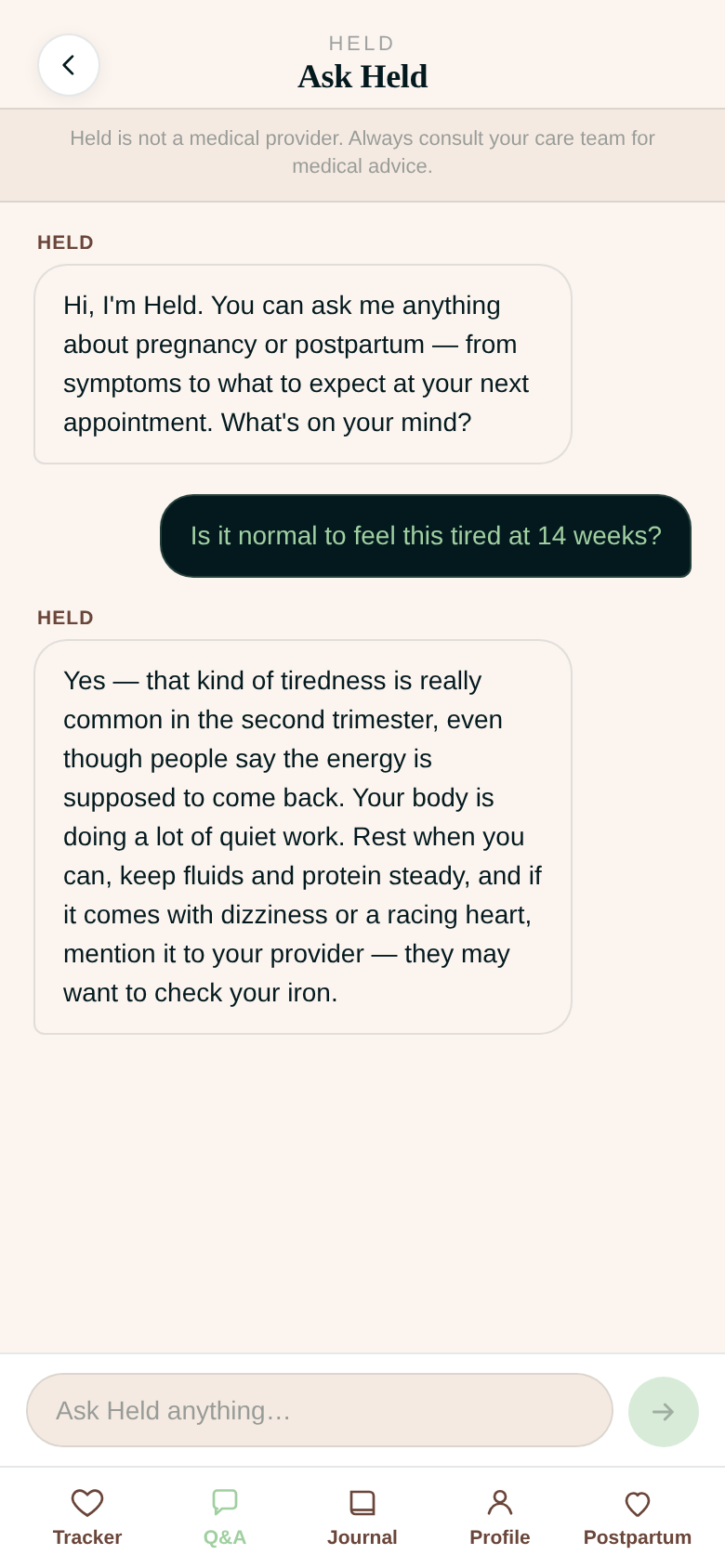
The AI Q&A: because clients had questions they were afraid to ask
Families asked me things they didn't feel comfortable asking their OB. The AI companion in Held is designed to hold that space: warm, non-judgmental, available at 3am. But I knew from clinical experience that some questions require a human provider. So the AI is explicitly designed to defer. When a question exceeds what it can address safely, it says so clearly and directs the user to their doula, their doctor, or their therapist. It will never spiral someone further into distress.
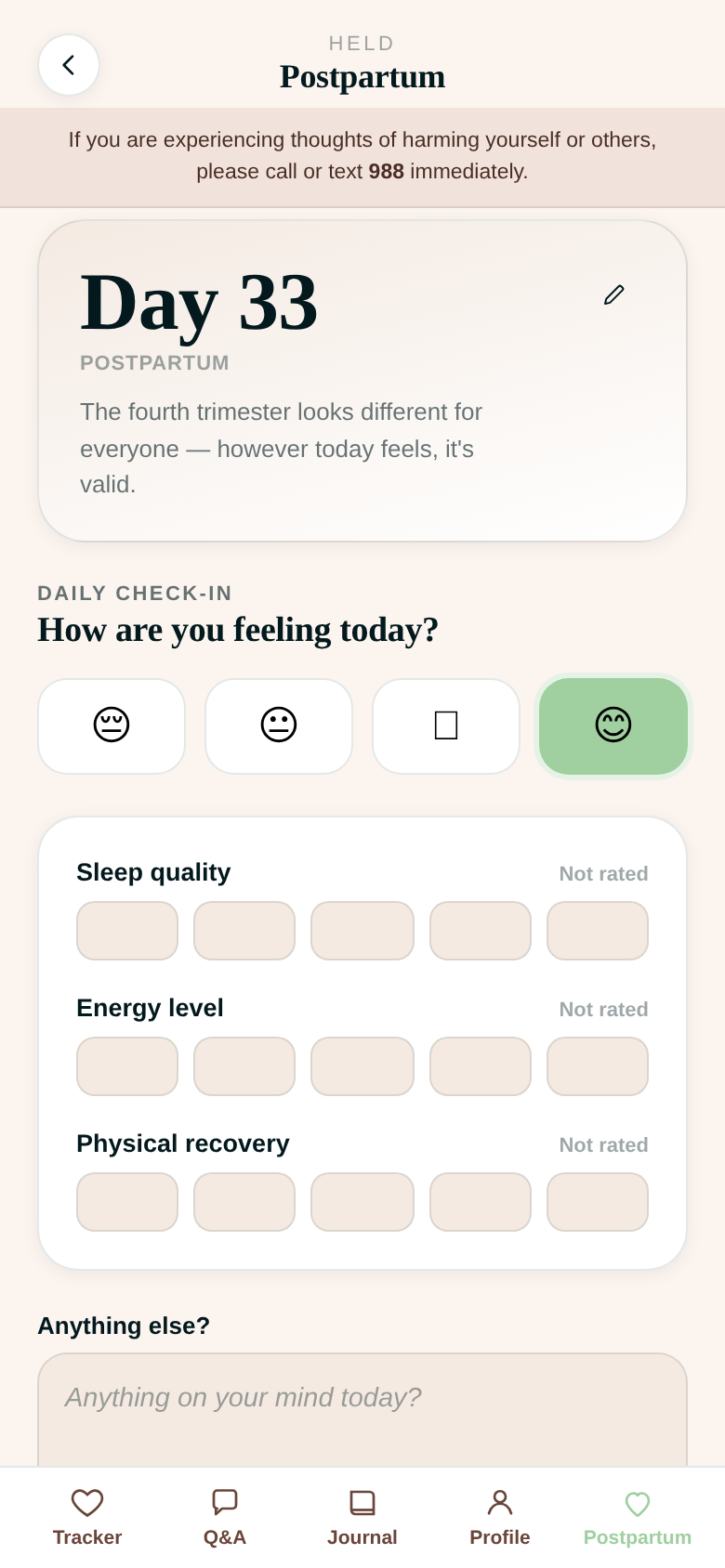
The crisis resource: because the fourth trimester can become a crisis
I've seen firsthand how quickly the postpartum period can darken. The 988 Suicide & Crisis Lifeline is always visible in the Postpartum screen, not buried in a settings menu. Designing that boundary was as important as designing the interface. The app will never be the only resource a person has.
The App
Five features. One continuous experience.
Held is a mobile-first AI companion that travels with you from the first trimester all the way through postpartum.
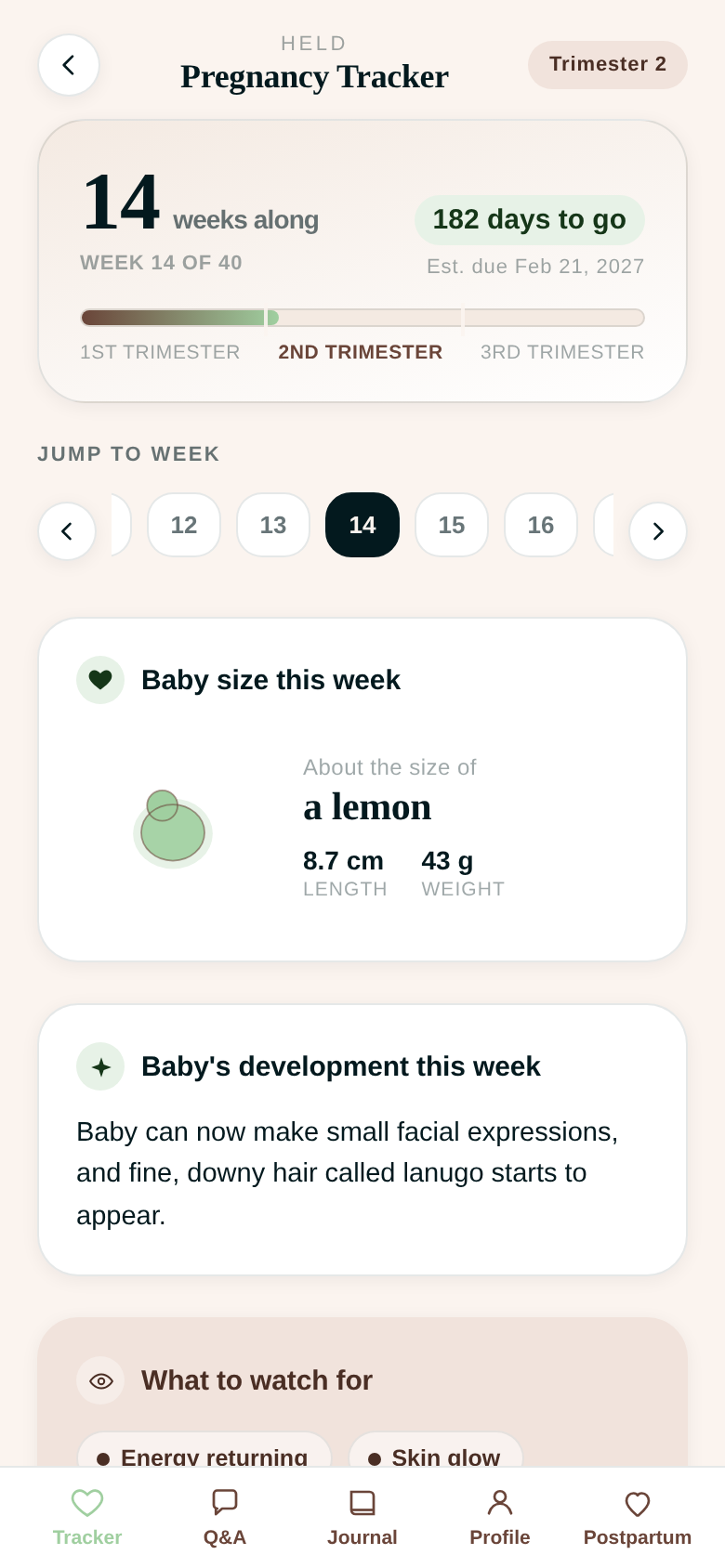
Pregnancy Tracker
Week-by-week guidance from weeks 1 to 40. Baby development, body changes, what to watch for. Gender-neutral language throughout, because not everyone carrying a pregnancy is a woman.
AI Q&A Companion
A real chat interface powered by Claude AI. Ask anything: symptoms, fears, what's normal. The AI responds like a knowledgeable doula friend: warm, calm, and always clear about when to call your provider.
Journal
A private space to write through the emotional experience of pregnancy and postpartum. Each entry captures your mood, the date, and your current week.
Birth Preferences
A screen most apps don't include. I added it because I've been in delivery rooms where a person's wishes weren't communicated to their care team. This screen exists because of that.
Postpartum Check-in
Daily mood, sleep, energy, and recovery tracking. The AI responds gently, and when someone signals distress, the 988 crisis line is always visible. Designing that boundary was as important as designing the interface.
Three core screens
What I Built It With
I didn't just design Held. I coded it.
Using Claude Code, I built a working, live app with real AI responses. Every screen you see is functional, not a mockup. This was intentional: the future of product design is designers who can build. I wanted to prove I'm one of them.
- Claude Code
- Claude API
- Figma
- ChatGPT
- WCAG 2.1
- Vercel
What It Taught Me
The clinical empathy came first. The code came second.
The most important design decisions in Held happened before I opened any tool. Knowing who I was designing for, and what they needed at 3am, shaped everything. I didn't have to interview users to understand the problem. I lived it with them, for nine years.
That's what those 100 births and 200+ families gave me. Not just a portfolio piece. A point of view. And that point of view is what I bring to every product I build.
Try Held on your phone
Open Held →